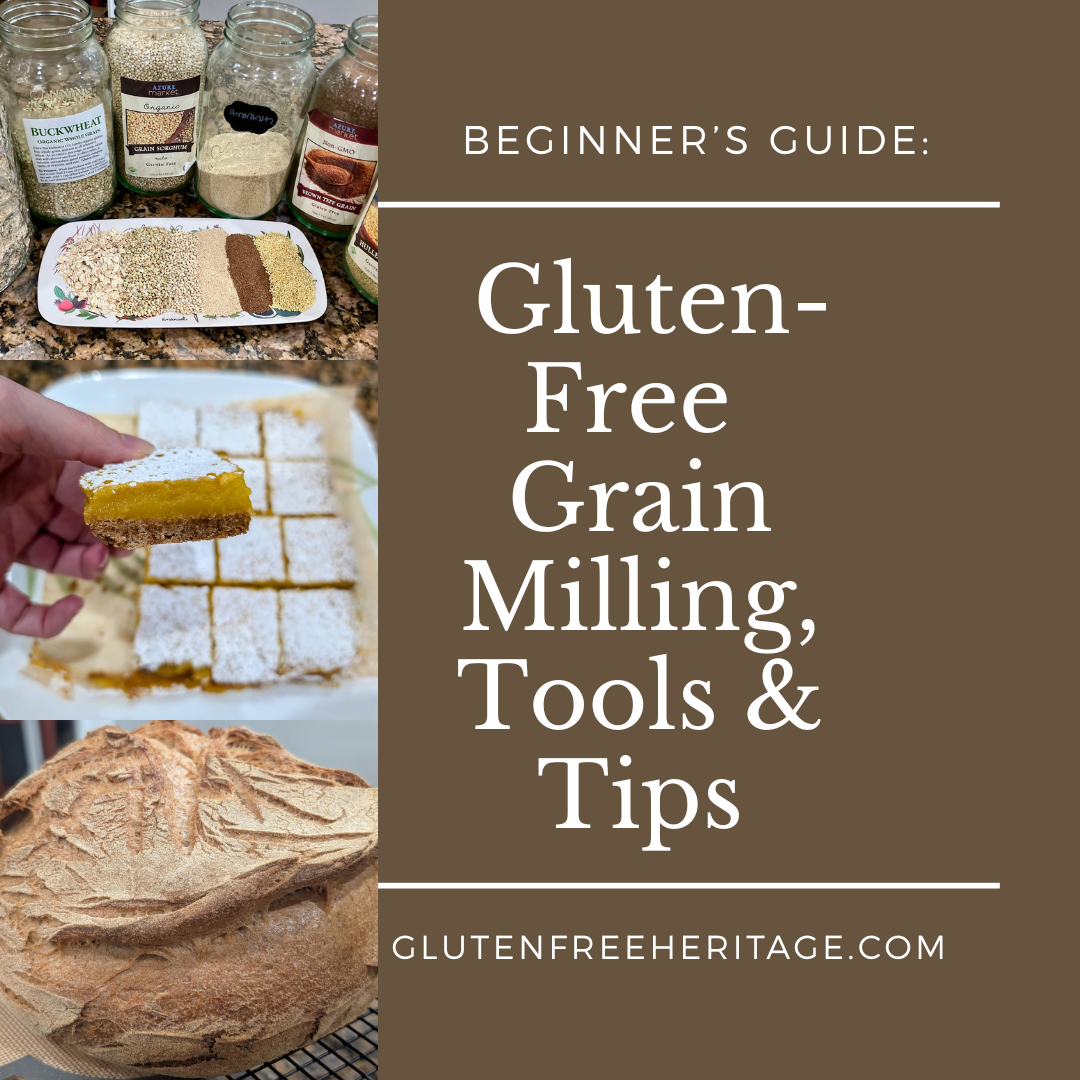
What You’ll Learn in This Guide
From manna in the desert to Jesus multiplying loaves, the Bible celebrates whole, nourishing grains. Unlike today’s hybridized or stripped grains, biblical bread was made from traditional wheat flour or whole grain flours—think Ezekiel bread, a blend of wheat, barley, beans, lentils, millet, and spelt (minus the cooking over dung, of course!).
But gluten isn’t for everyone. Whether managing gluten intolerance, a wheat/gluten allergy, or an autoimmune condition like Hashimoto’s, gluten can trigger mild to severe inflammation. This guide shows you how to mill your own grains at home, produce fresh flour, and bake excellent gluten-free baked goods for everyday use.
Whether it’s your first time trying milling flour or you’re seeking the right tools for the best results, this guide helps you navigate the tasty world of gluten-free baking with simple steps.
Why Fresh Milling Matters
Fresh milling preserves nutritional value, enhances flavor, and improves digestibility. Store-bought gluten-free flour often contains additives, gums, and standard components that affect the texture of your flour.
Benefits of Milling Your Own Flour:
- Keeps whole fiber and natural nutrients intact
- Produces fluffy flours for soft sandwich loaves and lighter textures
- No additives or gums, giving the finished product a pure, wholesome taste
- Allows for soaking, sprouting, or souring to improve digestion
A great advantage: freshly milled flour allows you to experiment with different gluten-free flours, including buckwheat flour, chickpea flour, white rice flour, almond flour, and cassava flour, each with its unique characteristics.
Best Gluten-Free Grains for Milling
Here’s a detailed breakdown of the best grains for home milling, including their flavor profiles, health benefits, and ideal uses. Each can be milled into fresh flour for gluten-free bread, pancakes, muffins, or even pizza crust.
1. Millet

Millet
Nutritional Highlights: Magnesium, phosphorus, fiber
Flavor Profile: Mild, slightly sweet
Best Uses: Muffins, pancakes, flatbreads, snack bars
Recipes to Try: Soft Millet & Sorghum Yeast Bread Rolls,
2. Oats
Oats
Nutritional Highlights: Beta-glucan, B vitamins, manganese
Flavor Profile: Mild and creamy
Best Uses: Cookies, smoothies, muffins
Recipes to Try: GF Oatmeal Chocolate Chip Bars,

3. Sorghum

Sorghum
Nutritional Highlights: Fiber, iron, protein
Flavor Profile: Mild, earthy
Best Uses: Breads, flatbreads, crackers
Recipes to Try: Gluten-Free Fig Quick Bread, Naan Skillet Bread
4. Teff
Teff
Nutritional Highlights: Iron, calcium, resistant starch
Flavor Profile: Nutty, sweet
Best Uses: Pancakes, porridge, breads
Recipes to Try: Mock Rye Bread,

5. Amaranth

Amaranth
Nutritional Highlights: Protein, iron, magnesium
Flavor Profile: Earthy, dense
Best Uses: Muffins, porridges, breads
Recipes to Try: Herb & Garlic Amaranth Crackers
6. Buckwheat
Buckwheat
Nutritional Highlights: Complete protein, magnesium, rutin
Flavor Profile: Nutty, hearty
Best Uses: Pancakes, crackers, soba noodles
Recipes to Try: Buckwheat Pancakes

7. Brown Rice

Brown Rice
Nutritional Highlights: Manganese, selenium, protein
Flavor Profile: Mild, gentle
Best Uses: Muffins, gravies, quick breads
Recipes to Try: Brown Rice Sourdough Starter,
8. Quinoa
Quinoa
Nutritional Highlights: Complete protein, folate, iron
Flavor Profile: Mild, slightly nutty
Best Uses: Muffins, pancakes, porridge
Recipes to Try: Quinoa Chocolate Cake

- Nutritional Highlights: Complete protein, folate, iron
- Flavor Profile: Mild, slightly nutty
- Best Uses: Muffins, pancakes, porridge
- Recipes to Try: Quinoa Chocolate Cake
9. Corn (Non-GMO)

Corn (Non-GMO)
Nutritional Highlights: Carotenoids, B vitamins, fiber
Flavor Profile: Sweet, nutty
Best Uses: Tortillas, arepas, polenta
Recipes to Try: Corn Muffins, Oven-Fried Breading, and grits! (try all of these in Mom’s Diner!)
Pro Tip: Mix different gluten-free flours to create amazing flours with unique characteristics for soft sandwich loaves, pizza crust, or other baked goods. This is the Fresh Milled Gluten-Free All-purpose Cup4cup Flour Blend that I use frequently.
Where to Buy Quality Gluten-Free Grains
Trusted sources:
- Amazon (check sourcing!)
- Anthony’s Goods
- Azure Standard (most of my grains come from here!)
- Bob’s Red Mill (GF line & flaxmeal)
- Bread Beckers
- Gluten-Free Prairie
- Grain Place Foods
- Hummingbird Wholesale
- NutriMill (they carry grains & mills)
- Pleasant Hill Grain
- Shiloh Farms
Local options: farmers’ markets, natural grocers, or grocery store health sections.
Tools for Fresh Milling
When I first started experimenting with home milling, I used the KitchenAid grain mill attachment. It’s a great first-time option for small batches of flour. Later, I upgraded to the NutriMill Classic, which quickly became my go-to. It mills much faster and has an enclosed storage canister—so the flour goes straight from the mill into the container with minimal mess. Most recently, I’ve upgraded to a NutriMill Harvest, a stone mill that provides an authentic stone-ground flour.
If you’re just beginning, a stand mixer with a grain mill attachment or even a high-powered blender can handle small amounts of grain. These are especially handy for oilier grains and seeds that don’t do as well in impact mills. When it comes to mixing up my doughs and batters with ease, I recently upgraded from a KitchenAid Stand Mixer to a Bosch Universal Plus Mixer. I love that it features a bottom-drive motor so I can easily access the top of the mixer for loading ingredients; it comes with a splash guard, an amazing dough hook, and its large capacity allows me to effortlessly double- and triple-batch recipes, saving time.
Many in our Fresh Milled Flour | Gluten Free Grains community also use mills like Mockmill, WonderMill, or Salzburger. But my focus—and affiliate partnership—is with NutriMill grain mills. Their line is especially well-suited for gluten-free grains, and they offer great options depending on your needs:
Starter Options
- Grain mill attachment for stand mixer – affordable, easy entry point
- High-powered blender – good for small batches and oilier grains
Upgrade Options: NutriMill Grain Mills

Integrated storage bowl reduces flour mess.
Impact mills are powerful and fast electric mill
Produces super-fine flour for soft, smooth baking
Perfect for dry gluten-free grains, such as rice, millet, and corn.

Ideal for frequent bakers or large families
Same power as the Classic, but quieter
Compact design with a convenient retractable cord
Built-in storage for flour makes cleanup simple

NutriMill Harvest (Stone Burr Mill)
Best for those who prioritize nutrition and tradition
Stone mill uses stone burrs to grind grains
Features slow-turning granite stones for gentle, traditional grinding
Retains more nutrients through low-heat milling
Beautiful wood finish—fantastic for countertop display
NutriMill Highlights at a Glance
- Classic → produces super-fine flour, easy to use, integrated storage canister for less mess
- Impact → quieter operation, compact design, perfect for large batch convenience
- Harvest → traditional stone burrs, low-heat milling for higher nutritional value, and a beautiful countertop design
All three NutriMill models handle dry, non-oily gluten-free grains with ease. If you’re ready to invest, you can get $20 off your purchase with [this affiliate link] and the code VINTAGEVIRTUES.
Pro Tips for Milling Flour
- Use a separate grinder (spice or coffee grinder) for flax, chia, or other oily seeds to prevent clogging your main mill
- Always mill grains at room temperature for the best results
- Store whole grains in a dark place to maximize shelf life and preserve nutrients
- Mill only what you need for each bake to keep flour at peak freshness
- Keep flour in an airtight container; refrigerate or freeze extra for longer storage
- Try mason jars with vacuum sealing for freshness and easy organization
Gluten-Free Binders & Boosters
Binders: psyllium husk powder, flaxseed meal, chia, eggs
Starches: tapioca starch, arrowroot, potato starch, cornstarch
Gums: xanthan, guar (use sparingly or avoid if sensitive)
Using the right combination improves the texture of your flour and finished product in your baked goods.

Grain-to-Flour Yield (Quick Reference)
| Whole Grain (Dry) | Approx. Flour Yield | Notes |
|---|---|---|
| 1 cup Millet | 1 1/4 cups of flour | Fine, slightly sweet |
| 1 cup Oats | 1 1/3 cups of flour | Best when fresh rolled or ground |
| 1 cup Buckwheat | 1 1/4 cups of flour | Use hulled groats |
| 1 cup Sorghum | 1 1/3 cups of flour | Mild, sweet taste |
| 1 cup Rice | 1 1/4–1 1/3 cups flour | Yields vary by variety |
| 1 cup Corn | 1 cup of flour | Use whole dried kernels |
| 1 cup Teff | 1 1/3 cups of flour | Fine, best stored cold |
| 1 cup Amaranth | 1 1/4 cups of flour | Nutty, sticky when wet |
| 1 cup Quinoa | 1 1/4 cups of flour | Mill dry. Most store-bought quinoa is pre-rinsed to remove bitter saponins |
Final Thoughts
Freshly milled gluten-free grains reconnect you with real food, tradition, and nutrition. Start small: one grain, one recipe. Try a muffin, pancake, or pizza crust. Experiment with alternative flours like almond meal, cassava flour, chickpea flour, or buckwheat flour to find excellent gluten-free flour choices.
Join our Fresh Milled Flour | Gluten-Free Grains Facebook group or comment below—let’s reclaim our own bread and the tasty world of gluten-free baking, one grind at a time.
References & Further Reading
- America’s Test Kitchen. How to Use Psyllium Husk in Gluten-Free Baking.
- America’s Test Kitchen. The How Can It Be Gluten-Free Cookbook.
- Asbell, Robin. The Whole Grain Promise.
- Bob’s Red Mill. How to Replace Eggs in Your Recipes.
- Celiac Disease Foundation. Gluten-Free Baking Tips.
- Desta, S. (2010). Overview of Teff Production, Use, and Research in Ethiopia. Journal of SAT Agricultural Research.
- FAO (1995). Amaranth: Ancient Crop for Modern Times.
- Hagman, Bette. The Gluten-Free Gourmet Bakes Bread.
- Hu, F. B. (2003). Plant-Based Diets and Cardiovascular Disease. The American Journal of Clinical Nutrition (AJCN).
- King Arthur Baking Company. Baking Without Eggs.
- O’Hara, J., & Day, L. (2019). Oats in Human Health. Nutrients.
- Publications International. The Gluten-Free Bible.
- Ranhotra, G. S., Gelroth, J. A., & Leinen, S. D. (1993). Properties of Sorghum and Millet. Cereal Foods World.
- Sathe, S. K., & Salunkhe, D. K. (1984). Bean Protein Functionality. Journal of Food Science.
- Serious Eats. The Science of Eggs.
- Taylor, J. R. N., & Schober, T. J. (2005). Sorghum and Millet in African Foods. Food Reviews International.
- USDA FoodData Central. https://fdc.nal.usda.gov/
- Weaver, C. M., & Plawecki, K. L. (1994). Dietary Calcium in Vegetarian Diets. The American Journal of Clinical Nutrition (AJCN).
Bonus Resources:
- NutriMill. Choosing the Right Grain Mill. https://www.nutrimill.com
- Gluten-Free Watchdog. Testing and Product Safety. https://www.glutenfreewatchdog.org
- Vintage Virtues. Fresh-Milled Gluten-Free Recipes & Guides. https://vintage-virtues.com/category/biblical-homesteading-feasts/moms-diner-recipes/fresh-milled-flour-gluten-free-grains/
Affiliate Disclosure
This post may contain affiliate links, including Amazon Associate links. That means I may earn a small commission—at no extra cost to you—if you make a purchase through one of these links. Your support helps cover the costs of running this blog and means a great deal. Thank you!
Leave a Reply