When my daughter, who mills her own flour, asked me about traditional German rye bread, I reminisced over how lovely it is. But rye is a gluten-containing grain, along with wheat and barley, and because gluten is something I avoid, rye flour simply isn’t part of my pantry.
Still, the question lingered. Could I create a gluten-free version that captured the dark color, hearty crumb, and unmistakable flavor profile of rye bread, without using rye flour at all?
That question turned into a great time of experimenting.
Reimagining Rye Without Gluten
When I thought about dark bread and traditional European loaves, teff came to mind. Teff is one of the world’s tiniest grains, full of nutrition, and workable in gf recipes. It has a naturally deep brown color, a mild earthy flavor, and a nutritional profile that sets it apart from other gluten-free grains. Teff is best known for its traditional injera flatbread, but it also performs beautifully in loaf breads and even desserts, like this teff pie! I grind teff grains I purchase from Azure Standard using my NutriMill Harvest. Save $20 off your own with code VINTAGEVIRTUES.
My initial thought was to use brown teff flour for color, a gluten-free sourdough starter for fermentation, and caraway seeds to recreate that classic rye flavor. Of course, I didn’t have a gluten-free sourdough starter or caraway seeds on hand. What I did have was fennel seed, which brings a tangy, licorice-like flavor that works surprisingly well in this mock rye bread.


From Concept to Dough
I started reviewing several gluten-free bread recipes, focusing on dry ingredients, wet ingredients, hydration, and structure. Teff bread can easily become dense if there isn’t enough liquid, so I knew this loaf would need much liquid compared to wheat breads. At the same time, structure is critical in gluten-free baking.
Because I avoid xanthan gum and guar gum, I rely on psyllium husk powder to build structure. Psyllium creates a gel that mimics gluten’s elasticity and supports the dough’s rise without the need for gums. For this recipe, I used psyllium husk powder, though whole psyllium husk can be used with adjustments.
Yeast provides the lift here. This is not a regular sourdough bread, but rather a yeasted loaf inspired by the flavor of sourdough. Commercial yeast makes the process more accessible, especially for a first-time gluten-free rye bread recipe.
Mixing and Fermentation
The dough comes together in the bowl of a stand mixer fitted with the paddle attachment. Gluten-free dough is not kneaded like wheat dough; instead, it resembles a thick paste. Begin by combining the wet mixture—warm water, yeast, olive oil, and a little honey. The warm water and honey activate and feed the yeast, jump-starting the fermentation process.
Once foamy, psyllium husk powder is mixed in at medium speed to form a gel. This step is essential and should be done before adding the dry ingredients. In a large bowl, whisk together brown teff flour, ground flaxseed, salt, and half of the fennel seeds. I measure in grams for accuracy. Teff basics matter here: teff is high in fiber, iron, protein, and calcium, making it a nutritional powerhouse among whole grains.
Although teff can be blended with brown rice flour, white rice flour, buckwheat flour, sorghum flour, tapioca flour, or even quinoa flour to create a flour blend, this recipe intentionally keeps teff as the dominant grain. Rye makes up the bulk of traditional rye breads, and here teff plays that role.
Pan Choice and Rise
Once combined, the dough is transferred into a loaf pan. I reach for my favorite 8×4 cast-iron enameled loaf pan. The high walls reinforce bread’s strength and encourage upward rise. Smooth the top, brush lightly with oil, and sprinkle remaining fennel seeds over the surface. Cover loosely with a tea cloth or plastic wrap.
The first rise happens at room temperature and usually takes about an hour. Gluten-free dough does not benefit from a second rise. In fact, it’s important not to over-proof yeasted breads. Bake when the loaf looks puffy and has risen to the top of the pan.
Baking and Cooling
Bake at 425°F. This high heat sets the structure quickly and supports oven spring. Bake for about 45 minutes, or until the internal temperature reaches at least 205°F. Once baked, remove the loaf from the bread pan and transfer it to a wire rack.
Cooling completely is essential. Use a sharp bread knife only after the loaf has cooled fully. Cutting too soon is one of the most common causes of gumminess in gf bread.
The Finished Loaf
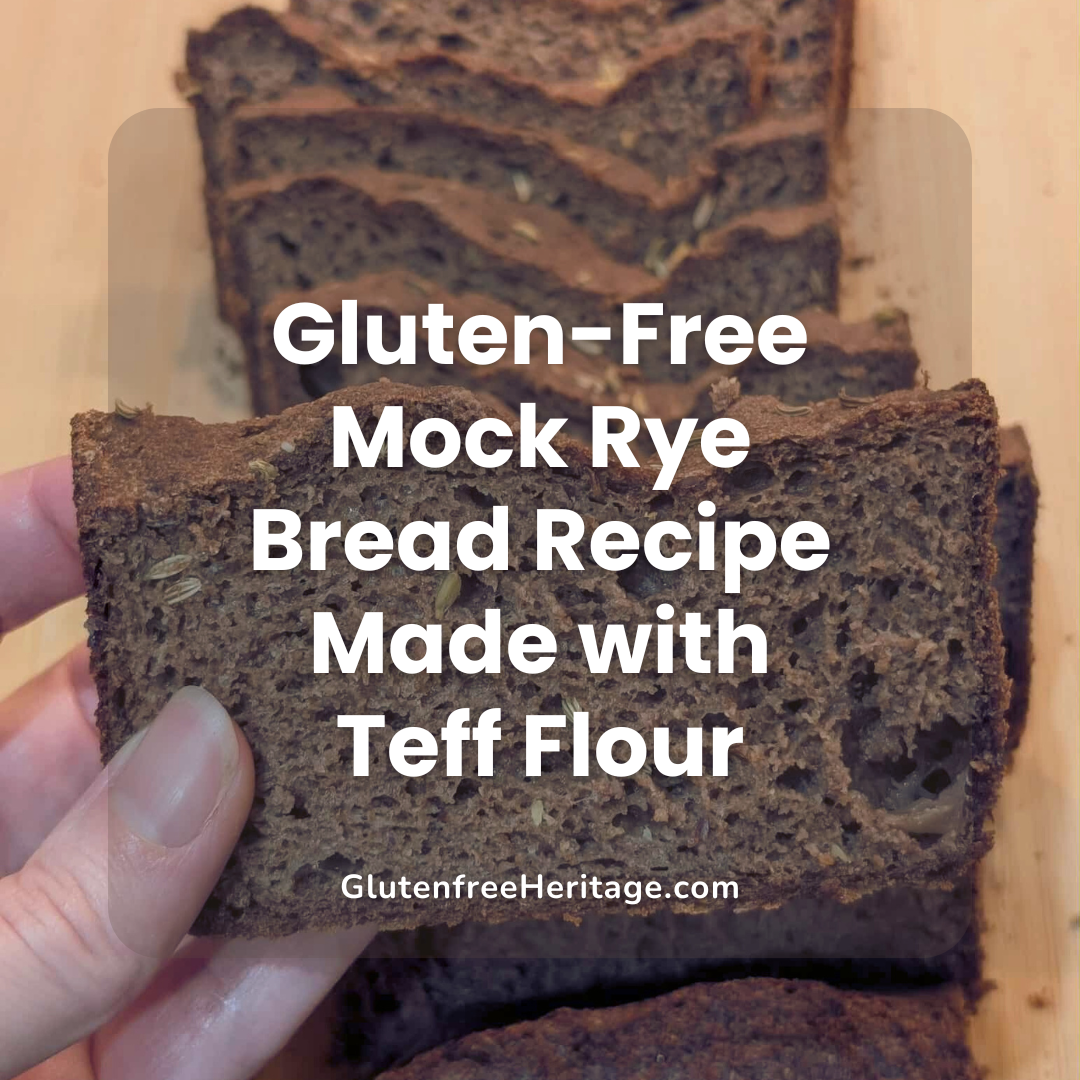
The result is a hearty, dark bread with excellent structure and a satisfying chew. It does not crumble, making it ideal for sandwich loaf recipes. The fennel seeds echo the flavor of caraway seeds, giving this gluten-free version a distinctly rye-like character without rye flour. If you enjoy buckwheat bread or pumpernickel-style loaves, this teff bread fits right in.

Gluten-Free Mock Rye–Style Teff Bread
Equipment
- 1 Grain Mill Get $20 Off with code VINTAGEVIRTUES at: https://nutrimill.com/VINTAGEVIRTUES
Ingredients
Ingredients:
Wet ingredients
- 2 teaspoons active dry yeast (≈ 6 g)
- 2 cups warm water (100–110°F) (≈ 410 g)
- 1 tablespoon olive oil (≈ 14 g)
- 2 teaspoons honey (≈ 14 g)
- ¼ cup Psyllium husk powder ≈18 g
Dry ingredients
- 2 cups teff flour (≈ 240 g)
- 3 tablespoons ground flaxseed meal (≈ 21 g)
- 1 teaspoon sea salt (≈ 6 g)
- 1 teaspoons Fennel Seeds (≈ 2 g)
Topping
- 1 teaspoons Fennel Seeds (≈ 2 g)
- Olive oil for brushing
Instructions
- Activate the yeast: In a small bowl, combine the warm water, yeast, olive oil, and honey. Stir gently and let sit 5–10 minutes, until foamy and active.
- Form the psyllium gel: Transfer the activated yeast mixture to a mixer bowl. With the mixer running, add the psyllium husk powder and mix 1–2 minutes, until the mixture becomes gel-like.
- Mix dry ingredients: In a separate medium bowl, whisk together the teff flour, ground flaxseed, salt, and fennel seeds until evenly combined.
- Combine wet + dry ingredients: Add the dry ingredients to the wet psyllium mixture. Mix thoroughly until a thick, sticky dough forms. Scrape down the bowl as needed. The dough should be cohesive and paste-like, not pourable.
- Transfer the dough to an 8 × 4-inch loaf pan (cast iron enamel works well): Smooth the top with an oiled spatula. Brush lightly with olive oil and sprinkle evenly with fennel seeds.
- Rise: Cover loosely with a tea towel or plastic wrap and let it rise to top of pan, about an hour.
- Bake: Preheat oven to 425°F. Bake uncovered for 45 minutes, until the internal temperature reaches at least 205°F.
- Cool completely before removing from pan and slicing. Enoy!
Variations and Notes
This is a fantastic bread, as it is. But some potential variations are molasses for honey and caraway seeds for fennel, for an even more authentic flavor. If you maintain a gluten-free sourdough starter, try replacing some of the liquid and flour with starter to create a hybrid loaf for a tangier flavor. An unused portion of the starter works well here. Don’t be afraid to experiment. Let me know if you make it differently!
A Gluten-Free Heritage Loaf
This gluten-free mock rye bread proves that traditional flavors don’t have to be left behind. Rye flour may belong to wheat breads, but this loaf stands confidently on its own. Whether you’re baking for celiac disease, gluten sensitivity, or curiosity, this recipe honors heritage while embracing gluten-free grains.
Happy baking.
Affiliate Disclosure
This blog post contains affiliate links. Purchases made through these links help support Gluten-Free Heritage at no additional cost to you. Thank you for supporting this work!
Leave a Reply